

When planning a commercial print project—whether launching a direct mail campaign, printing corporate annual reports, or producing event catalogs—one fundamental technical decision dictates your budget, turnaround timeline, and final aesthetic: digital printing vs. offset printing. Both technologies produce exceptional visual quality, but their underlying manufacturing mechanics, setup economics, and volume efficiencies serve vastly different project requirements.
What Is the Primary Difference Between Digital and Offset Printing?
The primary difference between digital and offset printing lies in setup mechanics and unit cost economics. Digital printing transfers electronic artwork directly onto paper using electrostatic toner or liquid ink, offering zero plate setup costs, rapid turnaround, and variable-data personalization for short-to-medium runs. Offset lithography uses aluminum plates and rubber blankets to transfer wet ink onto paper, requiring higher initial setup costs but delivering unmatched per-unit cost savings and precise Pantone color fidelity on high-volume production runs.
Understanding where these two processes diverge empowers print buyers, brand directors, and event coordinators to maximize their production budget without sacrificing color accuracy or paper flexibility.
Understanding the Mechanics: How Each Technology Works
To choose the right press for your project, it helps to understand how ink meets paper on the production floor:
- Offset Lithographic Printing: Operates on the chemical principle that oil and water do not mix. Digital computer-to-plate (CTP) systems laser-etch your artwork onto aluminum plates for each ink color (Cyan, Magenta, Yellow, Black, plus optional spot Pantones). Ink is rolled onto the plate, transferred to a rubber blanket cylinder, and pressed onto continuous sheets or rolls of paper at speeds exceeding 15,000 sheets per hour.
- Digital Production Printing: Eliminates physical printing plates entirely. High-speed digital presses use electrostatic charging, liquid electro-ink, or high-definition inkjet arrays to deposit micro-fine pigment particles directly onto the sheet in a single continuous pass. Because there are no mechanical plates, every successive sheet through the press can feature unique variable text, addresses, barcodes, or imagery.
Digital vs. Offset Printing Decision Matrix
| Production Variable | Digital Production Printing | Commercial Offset Printing | Decision Winner |
|---|---|---|---|
| Turnaround Speed | Same-day to 48 hours (Zero plate setup) | 3 to 7 business days (Plate making & drying) | Digital |
| Volume Sweet Spot | 1 to 2,500 units | 2,500 to 500,000+ units | Volume Dependent |
| Unit Cost on Long Runs | Flat cost per sheet (no economies of scale) | Cost per unit drops dramatically at scale | Offset |
| Variable Data / Personalization | 100% dynamic (every piece can be unique) | Static only (all sheets identical) | Digital |
| Pantone Spot Color Matching | Simulated CMYK gamut approximation | True physical Pantone ink formulation | Offset |
| Substrate Flexibility | Standard paper weights up to 18pt cardstock | Extensive (plastics, chipboard, 24pt+, metallics) | Offset |
The Economics of Run Length: Finding the Crossover Point
Every commercial print project has an economic "crossover point" where offset becomes more cost-effective than digital:
- Short Runs (Under 1,500 to 2,500 Pieces): Digital printing is almost always less expensive. Because you do not pay for four to six custom metal plates, press makeready, or sheet calibration waste, your entry cost is minimal.
- Long Runs (Over 2,500 to 5,000 Pieces): The initial plate and makeready investment of offset printing amortizes across the larger run. Once an offset press is calibrated, it prints thousands of impressions per hour using high-volume bulk inks, driving the unit cost down to pennies per piece.
Color Management and G7 Master Certification
Historically, offset printing delivered noticeably sharper color and smoother ink gradients than early digital copiers. Today, advanced high-speed digital presses reproduce ultra-fine lines, micro-type, and vibrant skin tones that rival offset lithography.
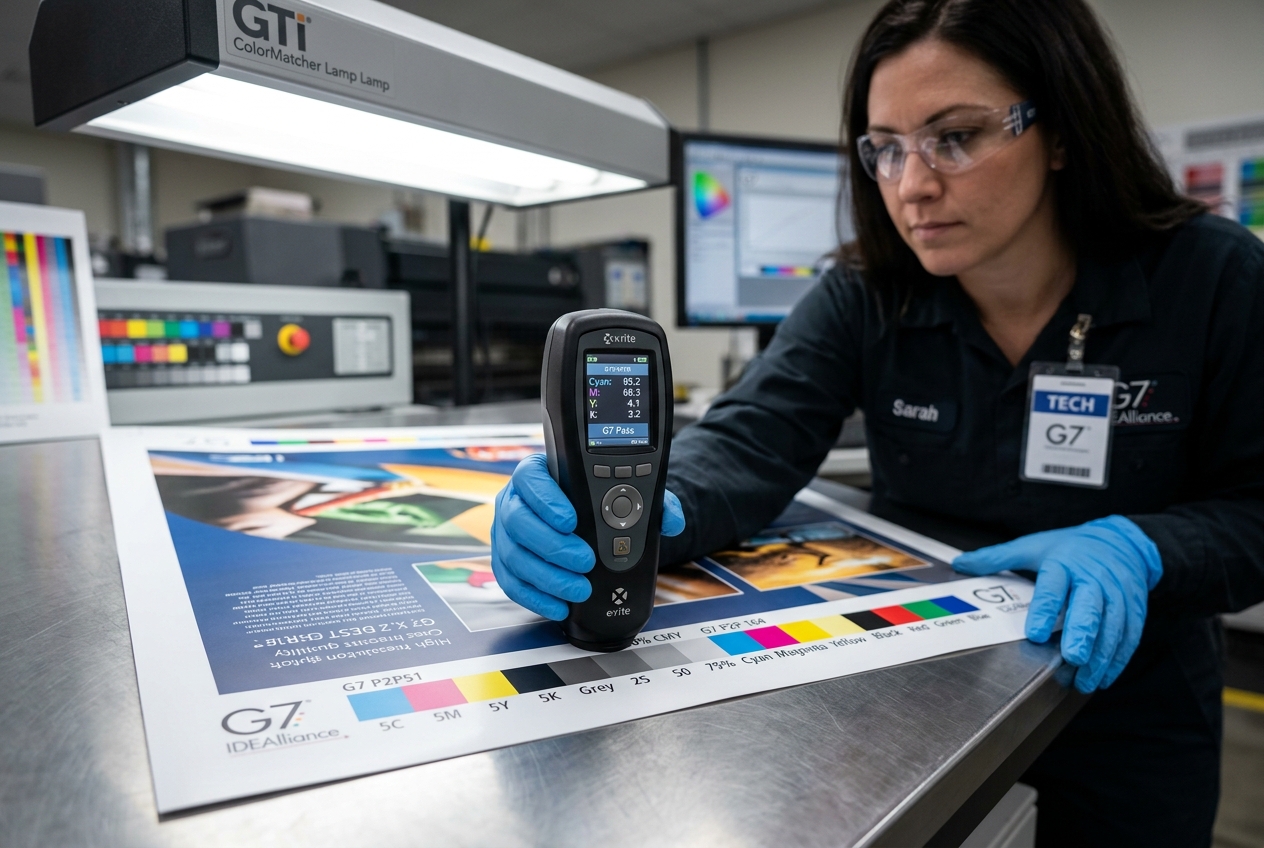
However, maintaining strict brand consistency across multiple marketing pieces—such as matching a digital variable letterhead to an offset annual catalog—requires rigorous press calibration. At emediagroup, we adhere to Idealliance G7 Master Printer specifications, aligning our digital presses and offset production floors to standardized spectrophotometric gray balance curves for identical visual output across every substrate.
When Should You Choose Digital vs. Offset?
Use this practical checklist to determine the ideal print method for your next production order:
- Choose Digital If: You need materials in hand within 24 to 72 hours; your quantity is under 2,000 units; or your project utilizes variable data (individual participant names, targeted postal addresses, customized QR codes, or personalized member credentials).
- Choose Offset If: You are printing 5,000+ brochures, catalogs, or direct mail inserts; your brand identity mandates exact Pantone spot-color inks (such as metallic gold or fluorescent pigments); or your project requires specialty oversized sheet sizes or extra-heavy packaging substrates.
Comprehensive Commercial Print Solutions Under One Roof
Rather than forcing your project into a single press technology, emediagroup operates both high-speed variable digital engines and conventional offset lithography in our Greenville facility. Our production engineers evaluate your quantity, budget, finishing specs, and timeline to route your job to the most efficient press equipment.
Explore our complete commercial capabilities on the emediagroup Print Solutions page to learn more about our scalable publishing, folding, binding, and variable mailing services.
Frequently Asked Questions
Can digital presses print exact Pantone (PMS) spot colors?
Digital presses simulate Pantone colors using advanced extended-gamut CMYK plus Orange, Violet, and Green inks. While modern digital engines accurately hit over 95% of Pantone swatches, strict corporate spot colors, metallics, and neon hues require dedicated physical ink mixes run on offset presses.
Why does offset printing have a higher initial setup cost?
Offset printing requires pre-press plate imaging (laser-etching metal plates for each color separation), physically mounting plates onto press cylinders, adjusting ink fountains, and running test sheets through the press until registration and neutral gray balance meet G7 tolerances.
What is variable data printing (VDP)?
Variable Data Printing (VDP) is a digital print technology that pulls information from a database spreadsheet to change text, graphics, recipient names, addresses, or barcodes on each individual printed piece without slowing press speed.
Optimize Your Next Print Run with emediagroup
Whether you need 250 personalized presentation folders or 100,000 multi-page product catalogs, our team delivers certified G7 color consistency, cost-effective run economics, and dependable turnaround.
Contact the emediagroup Commercial Print Team today or call 877.866.7223 to review your project specifications and receive an engineered print estimate.
0 Comments