

A great race bib does far more than display a number. It functions as the central operational hub on course—identifying participants, providing clear visual cues for course marshals and medical staff, housing timing transponders, and delivering premium sponsor visibility. For race directors, ordering custom race bibs requires balancing graphic layout, substrate durability, variable runner data, and firm production deadlines.
What Should Race Directors Consider Before Ordering Custom Race Bibs?
Before ordering custom race bibs, race directors must evaluate four core operational requirements: field size, environmental conditions (rain, sweat, mud), timing system integration (RFID chip vs. manual backup), and variable data fields (runner names, corral waves, emergency contacts). Establishing these specifications upfront prevents costly reprint cycles and timing misreads.
A local community 5K with morning-of packet pickup has vastly different requirements than a multi-wave road marathon or an off-road endurance triathlon. Start by defining the physical conditions your bib will endure:
- Weather Exposure: High heat, humidity, driving rain, or mud require synthetic, tear-proof substrates that remain legible when soaked.
- Packet Fulfillment Workflow: Will bibs be pre-stuffed into runner packets weeks ahead, or assigned dynamically on-site using dynamic barcodes?
- Medical & Safety Requirements: Emergency contact data and medical check-boxes on the reverse side are critical safety standards endorsed by event governing bodies such as USA Track & Field (USATF) to assist first responders on course.
Choosing the Right Bib Size, Substrate, and Layout
The standard road race bib measures 7.5" x 6", providing sufficient surface area for distant number recognition without interfering with a runner's stride. Youth events, cycling races, and triathlons often use compact 6" x 4" or specialized frame/seatpost numbers.
Race Bib Substrate Comparison
| Substrate Type | Tear Resistance | Water & Sweat Resistance | Best Suited For | Typical Finishing Options |
|---|---|---|---|---|
| Spunbonded Polyolefin (Tyvek®) | Maximum (Virtually Indestructible) | 100% Waterproof | 5Ks, Half/Full Marathons, Mud Runs | Corner punch holes, perforated tear-off stubs |
| Synthetic Poly Paper (Pretex) | High | Water & Weather Resistant | Multi-day festivals, cycling, trail races | Safety pin holes, custom die-cut shapes |
| Laminated Cardstock | Moderate | Splash Resistant Only | Single-use indoor meets, fun walks | Straight-cut, string punch |
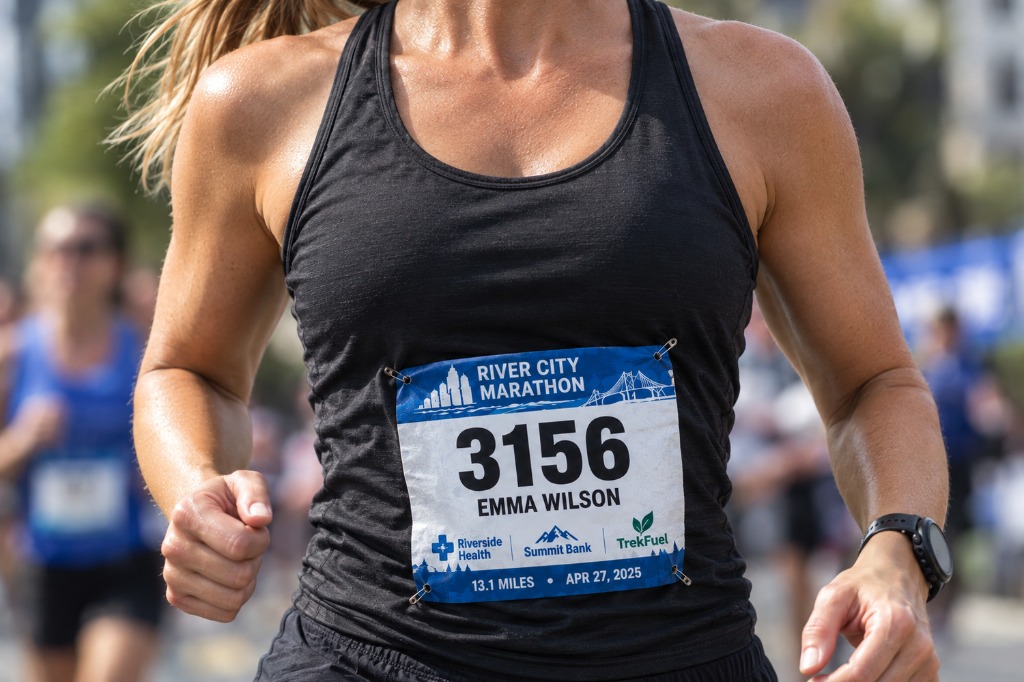
Establishing Visual Hierarchy
Do not crowd every square inch of the bib face. Maintain a disciplined layout:
- Participant Number (Primary Focus): Must occupy at least 35–45% of the bib face in high-contrast, bold typography readable from 50+ feet.
- Event Name & Title Sponsor: Anchored cleanly across the top or bottom header bar.
- Variable Runner Data: Placed directly beneath the main number (name, age division, corral wave).
- Secondary Sponsor Placement: Distributed along the lower margin or on perforated tear-off baggage/meal stubs.
Variable Data Printing: Preparing Your Participant Data
Modern digital printing allows complete variable-data customization—every single bib can feature individualized runner names, assigned waves, start corrals, medical alerts, and customized QR codes linking directly to live race results.
To guarantee zero production errors, follow these data hygiene rules before transmitting your athlete roster:
- Lock Column Headers: Maintain standardized headers (
Bib_Number,First_Name,Last_Name,Wave,Corral). - Preserve Leading Zeros: Format bib number columns as text in your spreadsheet so numbers like
0042do not collapse into42. - Eliminate Duplicate Records: Cross-reference bib numbers to ensure no duplicate assignments exist in the dataset.
- Establish a Hard Registration Freeze: Set a firm cutoff date for your primary bib production run, and print an allocated buffer of unassigned generic bibs to service late transfers and race-day registrations.
Integrating RFID Timing and Back-of-Bib Utilities
If your event utilizes chip timing, the bib serves as the carrier for your RFID transponder. Timing companies require exact antenna placement (foam-backed single or dual UHF RFID tags) calibrated to read at high runner density over ground mats.
Coordinate directly between your timer and printer early. Your print partner should supply verification logs confirming that the visual printed bib number matches the hexadecimal encoded string on the RFID chip.
Do not waste the reverse side of the bib. The back offers prime real estate for:
- Participant emergency contact form and medical allergy declarations
- Course elevation profile and key aid station mile markers
- Baggage check numbers aligned with the front tear-off stub
- Post-race festival maps, shuttle details, or sponsor coupon QR codes
Build a Reliable Production and Delivery Timeline
Bib ordering should never be a last-minute scramble. A smooth production timeline accounts for data reconciliation, graphic proofs, press setup, precision hole punching, sorting by wave, and transit:
- 4–6 Weeks Out: Finalize bib dimensions, sponsor logo lockups, and place the base production order.
- 2–3 Weeks Out: Close standard registration, export cleaned athlete data, and approve digital variable-data proofs.
- 10–14 Days Out: High-speed digital printing, RFID application, sequential packing, and quality control verification.
- 5–7 Days Out: In-hands delivery at your packet-pickup headquarters, sorted and labeled by bib sequence.
Single-Source Event Logistics: Beyond the Race Bib
Managing multiple print vendors under tight race deadlines creates unnecessary communication risks. Choosing a dedicated production partner capable of handling your complete event footprint streamlines logistics, guarantees exact brand color matching, and reduces shipping overhead.
From durable Tyvek bibs and waterproof cycling numbers to start/finish line truss banners, mile marker feather flags, and custom participant medals, our dedicated team at emediagroup manufactures complete race-day solutions under one roof.
Explore our full commercial capabilities on the emediagroup Endurance Sports page to discover our high-volume bib production and custom event packages.
Frequently Asked Questions
What is the standard size for a road race bib?
The industry standard size for 5K, 10K, half marathon, and marathon bibs is 7.5 inches wide by 6 inches tall (7.5" x 6"). This dimension provides optimal readability for finish-line cameras and race officials while resting comfortably on the torso without flapping or restricting movement.
Can participants write on Tyvek race bibs?
Yes. Spunbonded polyolefin (Tyvek®) accepts standard ballpoint pens and permanent markers (such as Sharpies) without smearing, making it ideal for participants to fill in emergency medical information on the reverse side.
How far in advance should race directors order custom bibs?
Race directors should ideally initiate their custom bib order 4 to 6 weeks before race day. This allows sufficient time to finalize sponsor logos, configure RFID timing specs, execute clean variable data proofs, and receive the bibs at least one week prior to packet pickup.
Ready to Print Your Next Event's Race Bibs?
Whether you need 200 bibs for an inaugural community 5K or 15,000 serialized RFID bibs for a major city marathon, emediagroup delivers certified color accuracy, bulletproof materials, and on-time reliability.
Contact the emediagroup Team today or call us at 877.866.7223 to request material samples, discuss variable data templates, and receive a prompt quote for your upcoming race.
0 Comments