
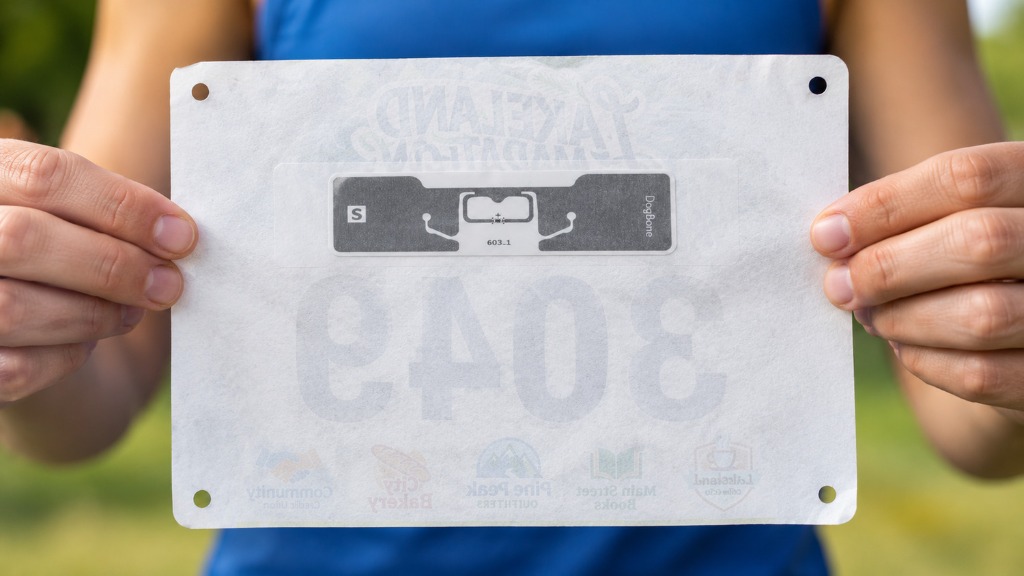
RFID race timing has transformed endurance events, replacing manual stopwatch logging with millisecond-precise participant tracking. However, flawless race-day results do not begin at the start line—they are engineered weeks earlier through compatible RFID tags, rigorous antenna placement, and a zero-error variable data workflow.
Why Is RFID Race Bib Tagging Critical to Event Timing Systems?
An RFID-enabled race bib serves as the physical carrier connecting an athlete's visual identity to the digital timing network. For chip timing systems to record split times accurately, the UHF transponder must remain physically protected, precisely spaced from body moisture, and perfectly correlated with the athlete's timing record across all ground mats and side antennas.
An RFID race bib is not a standalone print product. It is an active operational bridge within an ecosystem comprising registration databases, UHF readers, overhead trusses, ground antennas, and timing scoring software. A breakdown at any single touchpoint—such as an improperly encoded hex string or misplaced antenna—leads to unread bibs, missed finish times, and administrative chaos on race morning.
Confirming Tag Compatibility and Antenna Physics
Timing equipment manufacturers design their hardware around specific radio frequency specifications. Before bib printing and inlay application begin, race directors and timers must align on the exact hardware profile:
- Frequency Protocol: Ultra-High Frequency (UHF) transponders operating within the 860–960 MHz spectrum, fully compliant with global GS1 EPCglobal Gen 2 and ISO 18000-6C standards.
- Moisture & Body Interference Spacing: Human bodies absorb RF energy. High-performance race bib tags feature a specialized closed-cell foam spacer (typically 2mm–3mm thick) between the inlay and the participant's body to prevent signal attenuation from sweat and torso proximity.
- Inlay Orientation: Antennas must match the linear or circular polarization of your timing provider's ground mats or overhead gantry arrays. Installing tags rotated 90 degrees can decrease read rates by more than 40%.
RFID Race Timing Transponder Architecture
| Transponder Setup | Foam Spacer Thickness | Antenna Configuration | Read Reliability | Recommended Event Profile |
|---|---|---|---|---|
| Single Foam UHF Tag | 2.0 mm – 3.0 mm | Single dipole / dual-loop inlay | 99.5%+ at mat crossings | 5K, 10K, Half Marathons, Charity Walks |
| Dual Foam UHF Tags | 2.5 mm per tag | Redundant dual-inlay arrays | 99.9%+ high-density fields | Major City Marathons (10,000+ runners) |
| Tear-Off Shoe / Ankle Tag | N/A (Rigid Encapsulation) | Omnidirectional transponder | Extreme conditions | Mud runs, triathlons, trail ultras |

The Data Pipeline: Correlating Athlete, Bib Number, and Tag Hex
The core objective of RFID race bib tagging is preserving data synchronization across three distinct identifiers:
- Participant Record: The runner's name, age division, wave assignment, and emergency contact details stored in the registration database.
- Visual Bib Number: The high-contrast numeric digits printed boldly on the weather-resistant Tyvek face.
- Electronic Product Code (EPC): The unique hexadecimal string electronically encoded into the silicon RFID microchip.
Top-tier bib production facilities utilize inline optical and RFID verification. As each bib leaves the press, an automated optical character recognition (OCR) camera reads the printed human-readable number, while an integrated RFID near-field reader interrogates the transponder chip. If the visual number and the encoded chip do not match within millisecond tolerances, the bib is flagged, isolated, and automatically reprinted without disrupting sequence continuity.
Critical Production Questions for Race Directors and Timers
Before releasing your artwork and registration files to production, establish clear operational protocols between your timing team and print partner:
- Pre-Production Sample Run: Will your printer supply a serialized physical test pack (e.g., 25–50 sample bibs) so your timer can verify antenna reads on physical mats prior to full-run press approval?
- Sorting and Fulfillment Sequence: How should the finished bibs be packed? Timers and packet-pickup crews often require bibs bundled by wave, corral, or strict numerical sequence rather than arbitrary packaging.
- Late Registration & Dynamic Assignment Buffer: How will late transfers be addressed? Maintain a dedicated buffer of generic unassigned RFID bibs pre-encoded with designated sequence numbers to prevent delays at expo check-in tables.
- Disaster Recovery Protocol: If a timing box or packet is compromised during transport, what is the guaranteed turnaround window for serialized replacement bibs?
A Unified Partner for Flawless Race-Day Logistics
Fragmenting your race production across separate graphic shops, tag converters, and sign fabricators introduces unneeded points of failure. When data changes hours before press time, having your print manufacturer and RFID tag applicator working on the same production floor ensures seamless communication and certified quality control.
At emediagroup, we combine advanced high-speed digital variable printing with precision automated RFID tag application. Every bib is engineered for tear-proof durability, G7 color consistency, and certified electronic read accuracy.
Discover our complete event production capabilities on the emediagroup Endurance Sports page to streamline your race-day operations.
Frequently Asked Questions
What is the difference between single and dual RFID tags on race bibs?
Single RFID tags feature one foam-backed transponder placed horizontally on the back of the bib, which is ideal for standard 5K and 10K community events. Dual RFID tags utilize two spaced transponders to provide hardware redundancy and maximize read rates in massive marathon fields where athlete density can create RF shadowing.
Why is foam backing required on race bib timing tags?
Human skin and moisture act as RF absorbers that attenuate UHF radio waves. A closed-cell foam backing creates a 2mm to 3mm physical spacer between the runner's torso and the antenna, allowing the RF energy to radiate efficiently into ground and overhead antennas.
Can safety pins interfere with RFID timing tag performance?
Standard safety pins placed through the four corner eyelets of the bib do not interfere with RFID reading. However, runners must never pierce the foam-backed tag itself with a pin or fold the antenna inlay, as damaging the aluminum trace can render the microchip unreadable.
Ensure Flawless Chip Timing for Your Next Event
Protect your event's reputation with zero-fail RFID race bibs manufactured to precise timing specifications. From small regional road races to premier international marathons, our team delivers complete verification logs and on-time reliability.
Contact the emediagroup Endurance Team today or call 877.866.7223 to request RFID sample bibs and coordinate specifications directly with your timing director.
0 Comments